HNC Home Services is now Home Service Heroes — same trusted team, new name.
Good Work Done By Good People
Your Home Deserves Heroes
From eaves cleaning to Christmas lights, we handle every corner of your home with skill, care, and a smile. Trusted by homeowners across the Greater Toronto Area (GTA).
Fully InsuredEvery job covered, every time
5-Star RatedHundreds of happy homeowners
Local & TrustedProudly serving our community
Staining your deck and fence protects the wood from weather damage while enhancing your outdoor space. In Woodbine Gardens, where moisture and seasonal temperature swings challenge wood finishes, proper staining keeps your investment looking sharp and lasting longer. Home Service Heroes has completed hundreds of deck and fence staining projects across the Greater Toronto Area, and we're sharing the exact process we follow to deliver professional results.
By the end of this guide, you'll understand how to prepare your surfaces, choose the right stain, apply it correctly, and protect your work for years to come. Whether you're tackling this yourself or deciding it's time to call a professional, you'll know what quality looks like.
Before any stain touches wood, the surface must be completely clean and free of dirt, algae, mildew, and old finish. In Woodbine Gardens, the damp climate means mildew grows quickly on untreated wood, and it will prevent stain from bonding properly. Use a pressure washer set to 1500-2000 PSI to remove buildup without gouging the wood. Keep the nozzle moving and maintain consistent distance-typically 12 inches from the surface.
After pressure washing, inspect for damaged or rotted boards. Soft spots indicate decay that must be replaced before staining. Once the wood is clean, let it dry completely. In humid conditions, this can take 48-72 hours. Moisture trapped under fresh stain leads to peeling and failure, so patience here saves money later. Run your hand across the surface-it should feel dry to the touch, not just surface-dry.
Smooth any rough patches, splinters, or areas where old finish is peeling. Use 80-120 grit sandpaper for rough work and 120-150 grit for final smoothing. Sand with the grain to avoid cross-grain scratches that show after staining. Pay special attention to handrails, step edges, and anywhere people touch frequently-these wear faster and deserve extra preparation.
Fill gaps between boards and nail holes with exterior-grade wood filler. If boards are warped or severely cracked, replacement is more durable than repair. Woodbine Gardens homeowners often find that addressing structural issues during staining prevents costly fixes in a year or two. Once repairs are complete and the filler is dry, sand smooth and vacuum all dust away. Dust prevents adhesion and creates a gritty texture under your stain.
Stain choice determines durability and appearance. Solid stains provide better UV protection and hide wood grain, making them ideal for older or less uniform wood. Semi-transparent stains let grain show through but require reapplication every 2-3 years. Water-based stains dry quickly and clean up easily; oil-based stains penetrate deeper and age beautifully but take longer to cure. For Woodbine Gardens, where winters are cold and wet, solid or semi-transparent exterior-grade stain rated for moisture resistance outperforms lighter finishes.
Always test your chosen stain on a hidden area-the underside of a deck board or a fence section facing your shed. Let it cure for at least one week before judging color and sheen. Lighting changes how stain looks, and UV exposure affects cure speed. Buying the right stain the first time costs less than stripping and restaining because you chose wrong.
Temperature and humidity matter enormously. Stain should be applied when temperatures are between 50-85 degrees Fahrenheit and humidity is below 85 percent. Avoid direct sun during application-work in shade when possible to prevent lap marks where one section overlaps another. Stir your stain thoroughly; pigment settles over time.
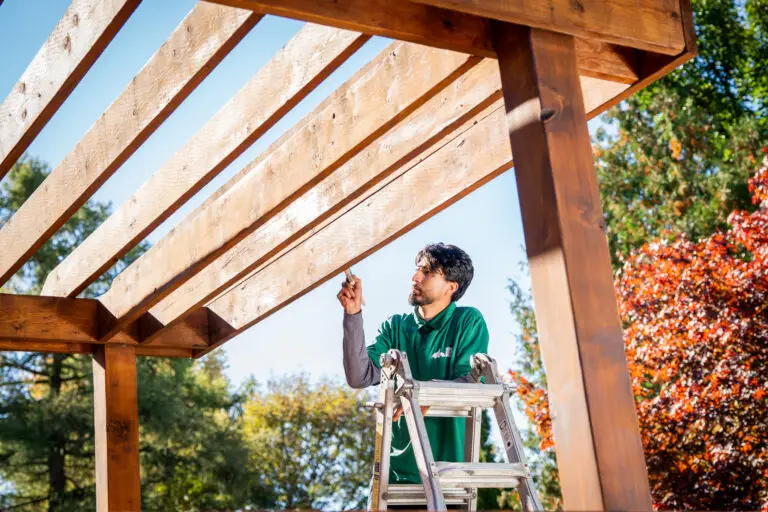
Apply stain with a brush, roller, or sprayer, working with the grain in long, even strokes. Use a 2-3 inch brush for detail work and a larger brush or roller for broad surfaces. Do not thin the stain unless the manufacturer specifies it-dilution reduces color depth and protection. Apply one coat first, let it dry per the label instructions (typically 4-24 hours), then apply a second coat for uniform color and maximum durability. Most exterior stains require two coats for lasting protection. Horizontal surfaces like deck tops get stained first, then railings, then the underside. This prevents drips from running onto freshly finished areas.
After final coat application, allow full cure time before foot traffic or furniture placement. This is usually 48-72 hours but varies by product and weather. Premature use leaves scuff marks that will not fade.
The difference between a staining job that lasts five years and one that lasts eight comes down to surface prep and cure time. Home Service Heroes invests these hours because they determine customer satisfaction. When you're ready to hire a professional for deck and fence staining in Woodbine Gardens or elsewhere in the Greater Toronto Area, choose a contractor who explains their process and does not rush cure time.
If you'd like to discuss your deck or fence, or if you'd prefer to have a professional handle the entire project, reach out to Home Service Heroes. We're here to answer questions and provide a clear estimate for your specific situation.
Cost depends on deck size, fence length, current condition, and stain type. Small decks (12x12 feet) range lower; larger decks and fences cost proportionally more. Professional staining in the Greater Toronto Area typically runs higher than DIY because labor, equipment, and quality stain add value. Contact Home Service Heroes for a free assessment and transparent pricing tailored to your project.
Most exterior stains last 2-4 years for semi-transparent finishes and 4-8 years for solid stains. Woodbine Gardens' damp climate accelerates wear, so inspect annually and plan for recoating every 3-5 years. Horizontal surfaces like deck tops weather faster than vertical fence boards. Neglecting restaining leads to wood damage that is far more expensive to repair.
No. New stain will not adhere to peeling old finish and will fail quickly. The old stain must be removed by pressure washing, sanding, or stripping depending on how firmly it is bonded. Proper prep takes time, but it is non-negotiable for a stain that lasts. This is one reason professional staining costs what it does-thorough removal and preparation prevent callback work.
Our Services
Everything Your Home Needs
“We show up on time, do the job right, and leave your property better than we found it.”Cyprian & Henryk, Co-Founders
Why Us
Why Homeowners Choose Us
We’re not just another contractor. We’re your neighbours, and we treat your home like our own.
On Time, Every Time
We respect your schedule. Show up when we say, finish when we promise.
Transparent Pricing
No hidden fees, no surprises. You get a clear quote before any work begins.
Quality Guaranteed
We stand behind every job. If something isn’t right, we make it right.
Ready to Get Started?
Request a free, no-obligation quote today. We’ll get back to you within 24 hours.